Configure Asset Types
Under , you can set up asset types as follows:
Create asset types (see Create an Asset Type)
Assign Asset Information Groups (AIGs) to asset types (see Assign AIGs to an Asset Type)
Assign event definitions to asset types (see Assign Event Types to Asset Type)
Assign survey data to asset types (see Assign Survey Data to Asset Type)
Assign risk models to asset types (see Assign Risk Models to Asset Type)
Assign library items to asset types (see Assign Library Items to Asset Type)
You must assign an asset type to each asset in the asset tree (see Edit Assets and Asset Types). The asset type determines what AIGs, event definitions, survey data groups, risk models or library items are applicable to particular assets.
Tip
You can also edit asset types and make assignments to it by choosing from the main toolbar on the ASSETS screen. It triggers the same Edit Asset Type dialog that is referenced below.
Create an Asset Type
To create a new asset type, proceed as follows:
Under , click
Add at the top of the Configuration - Types dialog.
Enter the following data:
Field/Checkbox Name
Description
Name
A name that uniquely identifies the asset type.
Category
The category of the asset type if you want to group asset types into categories.
Description
You can optionally provide more descriptive information about the asset type. This can be a maximum of 100 characters.
Asset Icon
Icon (16×16 px) representing the asset type in the asset tree. Click the ellipsis (…) to select an icon. If none is selected, the default icon is used.
Tip: When selecting an icon, you can click Connections to see which asset types already use the icon.
Prevent Duplicates
If ticked, assets of this type must have unique names. This means that you will not be able to create two assets with the same name under this asset type.
Is Primary Asset Type
Marks this asset type as a primary grouping category. This setting can be used for reporting, dashboards and functions to organise and group assets.
Click OK to save your changes.
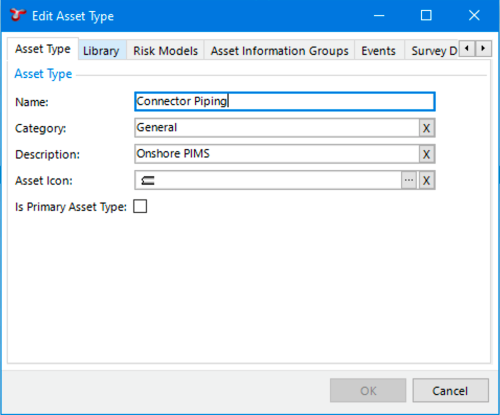
Result
The new asset type appears in the Configuration - Types dialog. When you edit it, additional tabs become available for assigning AIGs, event types, survey data, risk models and library items.
Assign AIGs to an Asset Type
If you assign an AIG to an asset type and you select an asset with that asset type in the asset tree, then that AIG will be available for editing under the Groups toolbar option on the Asset Information tab.
To assign an AIG to the asset type, proceed as follows:
Under , select the relevant asset type.
Choose Edit to launch the Edit Asset Type dialog.
On the Asset Information Groups tab, choose
Select the required AIG from the list and click OK.
Click OK in the Edit Asset Type dialog.
Assign Event Types to Asset Type
If you assign an event type (see Configure Event Types) to an asset type, then, on the INSPECTION screen, you can create events only with that event type for the particular asset with that asset type. For example, on the Event Listing tab, when you click Add Event, only the assigned event types will be available for selection when you create a new event. Also, you can import only events with the assigned event types.
To assign an event type to the asset type, proceed as follows:
Under , select the relevant asset type.
Choose Edit to launch the Edit Asset Type dialog.
On the Events tab, choose
Select the required events from the list and click OK.
Click OK in the Edit Asset Type dialog.
Assign Survey Data to Asset Type
If you assign a survey data form (see Configure Event Types) to an asset type, then survey data of that type can be logged against assets of that type.
To assign a survey data form to an asset type, proceed as follows:
Under , select the relevant asset type.
Choose Edit to launch the Edit Asset Type dialog.
On the Survey Data tab, choose
Select the required survey data form from the list and click OK.
Click OK in the Edit Asset Type dialog.
Assign Risk Models to Asset Type
If you assign risk models to an asset type, then you can assign only those risk models to assets with that particular asset type. That is, on the Risk tab, when you click Assign to <name of asset>, you can choose only from the risk models that have been assigned to that asset type. For more information, see Assign Risk Models and Scenarios.
To assign a risk model to the asset type, proceed as follows:
Under , select the relevant asset type.
Choose Edit to launch the Edit Asset Type dialog.
On the Risk Models tab, select the required risk models from the list. You can choose Select All to select all items in the list or Clear Selection to remove a selection.
Click OK in the Edit Asset Type dialog.
Assign Library Items to Asset Type
If you assign a library item to an asset type and you select an asset with that asset type in the asset tree, then the assigned library items will be available on the Library tab for that asset.
To assign a library item to the asset type, proceed as follows:
Under , select the relevant asset type.
Choose Edit to launch the Edit Asset Type dialog.
On the Library tab, choose
In the Add Library dialog, specify the main properties and upload the required library item. For detailed information, see Add/Edit Library Dialog.
Click OK in the Edit Asset Type dialog.
For more information about managing library items, see Library Items.
See also